
For the Pakistani bride who wants her marriage to actually work.
Get This First Reality Based Bride Guide And You Will Know Exactly
What questions to ask him before the nikah?
How to make sure he never loses interest in you after marriage?
How to protect your privacy in joint family structure?
How to talk about money without sounding like a gold-digger?
How to get loved, respected, and cared like in your own home?
The reason most Pakistani marriages quietly break.
It is not because the husband was secretly cruel.
It is not because the saas was a monster.
It is not because the bride was too modern, too traditional, too quiet, too loud.
It is because nobody had the conversations.
You have met your fiance four times.
Once with your father in the room.
Once at the engagement.
Twice on the phone, where you were both too nervous to say anything real.
You know his name.
You know his job title.
You know his sister's Instagram.
You do not know what he is like when he's tired.
You do not know what he does when his mother criticizes you.
You do not know what he expects from a wife.
You do not know what he assumes you have already agreed to just by saying qabool hai.
You will find out.
You will find out one assumption at a time, one fight at a time, one quiet evening at a time, for the next five years.
This is how good Pakistani girls end up sitting in their sasural at 4am wondering when they became someone they don't recognize.
Not because they were weak.
Because they were unprepared.
NOW AVAILABLE FOR
INSTANT DIGITAL DOWNLOAD
Only A Few Days Left
Only Pkr 5500 Pkr 1500
Save Pkr 4000 today
Download New Bride Guide For Pkr 5500 Just Pkr 1500! Delivered instantly. Start reading in the next 2 minutes.
Now Available For Instant Download

Here's What It Meant for You and Your Marriage
Every Pakistani marriage is built on one thing and one thing only — the conversations you have before the wedding, and the moves you make in the first 30 days after.
And those conversations and those moves are largely based on knowing exactly what to say, when to say it, and what never to say at all.
Not knowing is also the single biggest challenge a bride will face in her quest for a marriage where she is respected, loved, and still herself five years in.
It's why good girls end up crying in bathrooms at 4am. Why saas never warms up. Why he stops talking by year two. Why the money fights start. Why you forget the sound of your own laugh.
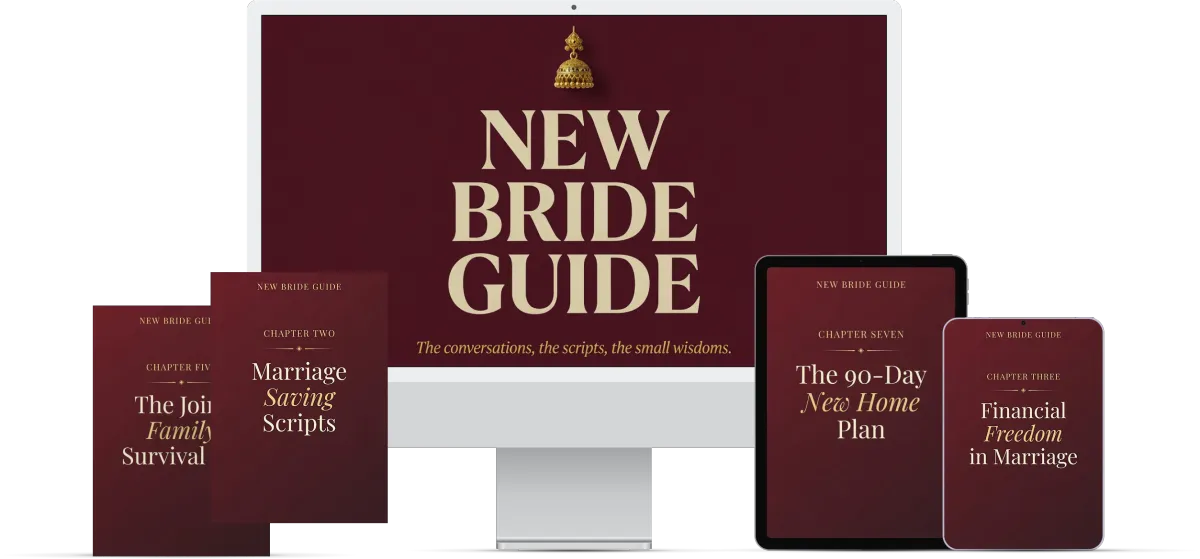
That's why we built the New Bride Guide to give you the exact 12 questions, the word-for-word scripts, and the day-by-day 30-day plan that lets you walk into your sasural prepared instead of praying (while staying fully yourself)...
And in turn, turn those conversations and scripts into a husband who actually talks to you, a saas who calls you meri beti and means it, your own money you never have to ask permission for, and a marriage where your friends, your job, and your laugh are all still intact.
Limited Time Special - Download The Digital Version For Only Pkr 1500
The Only System You'll Ever Need To Build A Marriage You Actually Want To Be In.
Backed By Our Unconditional 30 Day Money Back Guarantee
Here's Everything You're Getting
For Only Pkr 1500 Today

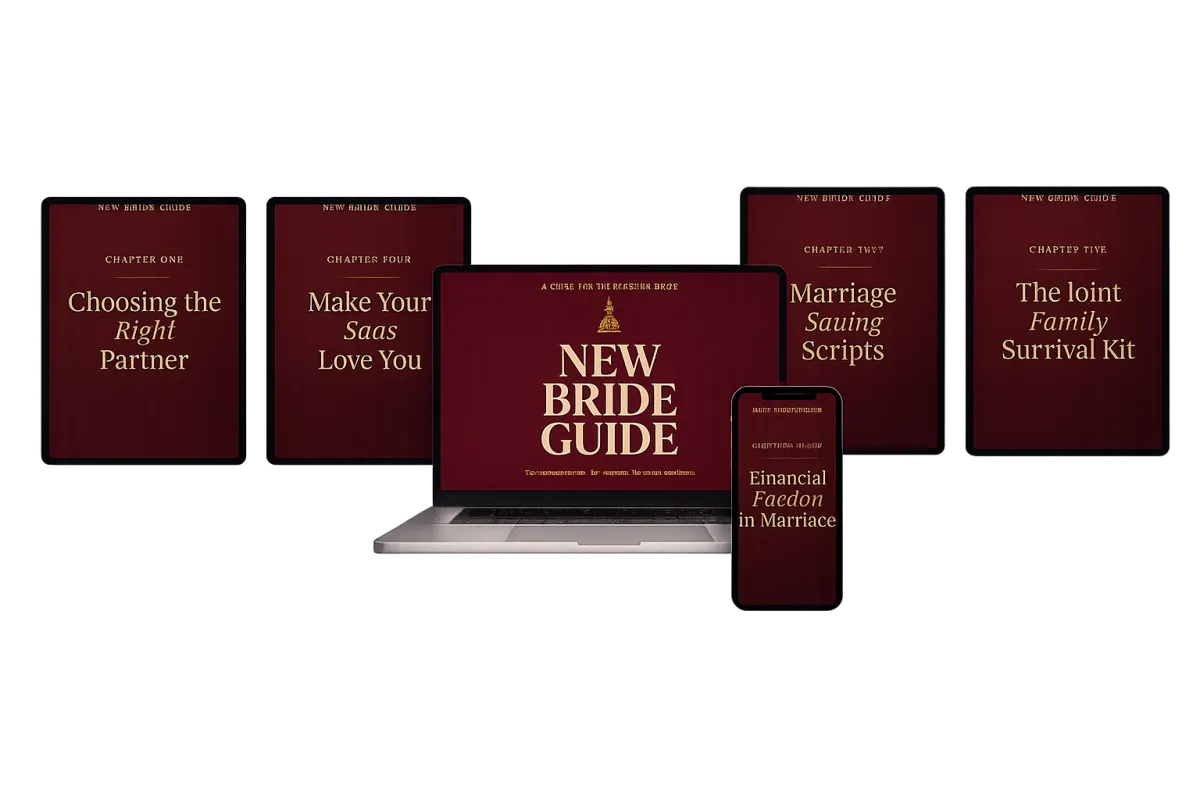
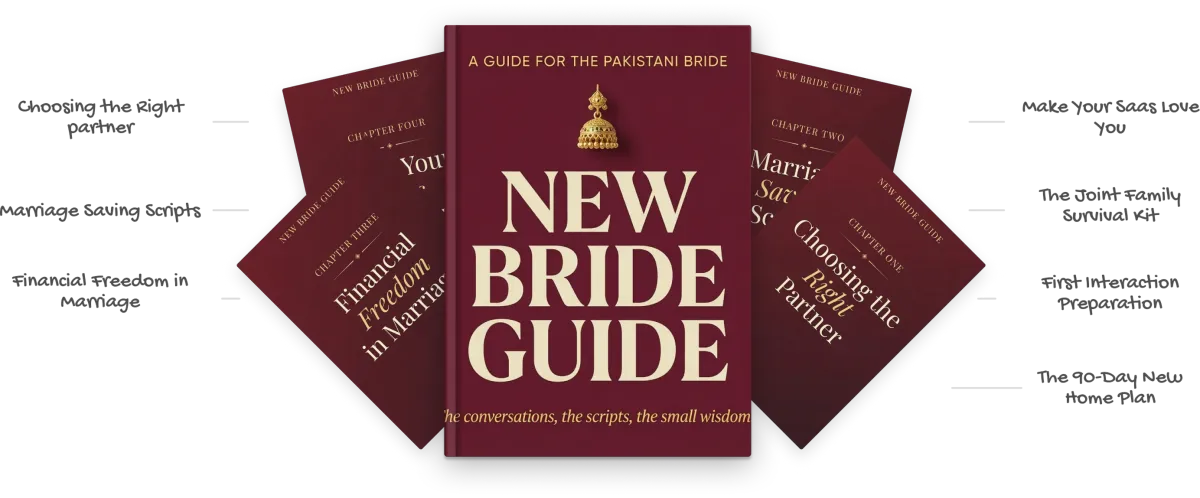
Choosing the Right Partner
The 12 questions, scripts to ask them without sounding demanding, and the 5 red flags nobody warned you about.
Marriage Saving Scripts
Word-for-word scripts for talking about visiting your parents, his mother's house, privacy, and the quiet rules of his family, without making him defensive.

Financial Freedom in Marriage
How to ask without sounding like a gold-digger, the 7 money questions every bride needs answered, and how to make sure you never have to ask permission for groceries.
Make Your Saas Love You
The first thirty days in your sasural decide the next thirty years. The seven things you should never say in week one. The seven you must. How to earn her love without becoming her servant. What to do when your husband says "don't fight with my mother."
The Joint Family Survival Kit
The boundaries you can set without ever using the word, how to create personal space in a shared house, and how to build allies instead of enemies among the women of the family.
First Interaction Preparation
A gentle, honest, halal-appropriate guide to the night nobody prepares you for. What to expect. How to feel safe. How to ask for time without feeling guilty. How a kind husband should treat you and how to recognize one who is.
The 90-Day New Home Plan
The 90-day adjustment plan, the bathroom-cry days and how to make sure they pass, and how to build a home in a house that isn't yours yet.
Here's Everything You're Getting
For Free Today
The 50-Question Compatibility Worksheet
A printable PDF you can fill out before your nikah, alone or with your fiance. The clearest way to see if you are actually walking into the right marriage.
Price : pkr 800 FREE
The Saas-Bahu Script Library
Twelve word-for-word scripts for the most common difficult moments with your mother-in-law. Memorize them once. Use them for the next thirty years.
Price : pkr 1200 FREE
The 30-Day Sasural Survival Calendar
A day-by-day plan for your first month in your new home. What to do. What to say. What to never do. Print it, fold it, keep it private. It works.
Price : pkr 1000 FREE
You Might Have Doubts
You might have doubt that this will work for you.
You might have doubt that Rs. 1500 can fix what your whole life didn't prepare you for.
You might have doubt that a book can change how your saas treats you.
You might have doubt that your husband, specifically your husband, would ever actually respond to scripts like these.
You might have doubt that you are the kind of girl who can have these conversations at all.
But you can't let doubt decide the rest of your life.
Because where you are right now, awake at this hour, reading a sales page for a book about your own wedding, that is exactly where doubt got you.
So let's look at every one of those doubts together.
This will work for you because every script in it has been tested with brides from every kind of family in this country. Conservative, liberal, Karachi, Lahore, Pindi, abroad. The scripts are written for a girl who has been told her whole life to stay quiet. You don't need to be brave. You just need to know what to say.
Rs. 1500 isn't fixing your life. It's handing you forty-eight hours of reading that compresses fifteen years of married women's regrets into two evenings. That's all. That's what you're paying for.
A book can't change how your saas treats you, but the first seven sentences out of your mouth on day two in her kitchen absolutely can, and that's what chapter four is.
Your husband is probably more open than you think. He's also scared. Nobody prepared him either. The scripts in chapter two are written for a man who wants to be a good husband and doesn't know how.
You are exactly the kind of girl who can have these conversations. If you weren't, you wouldn't have read this far. Quiet girls read. Quiet girls prepare. Quiet girls become the women everyone else underestimated.
Having doubts has held you back long enough.
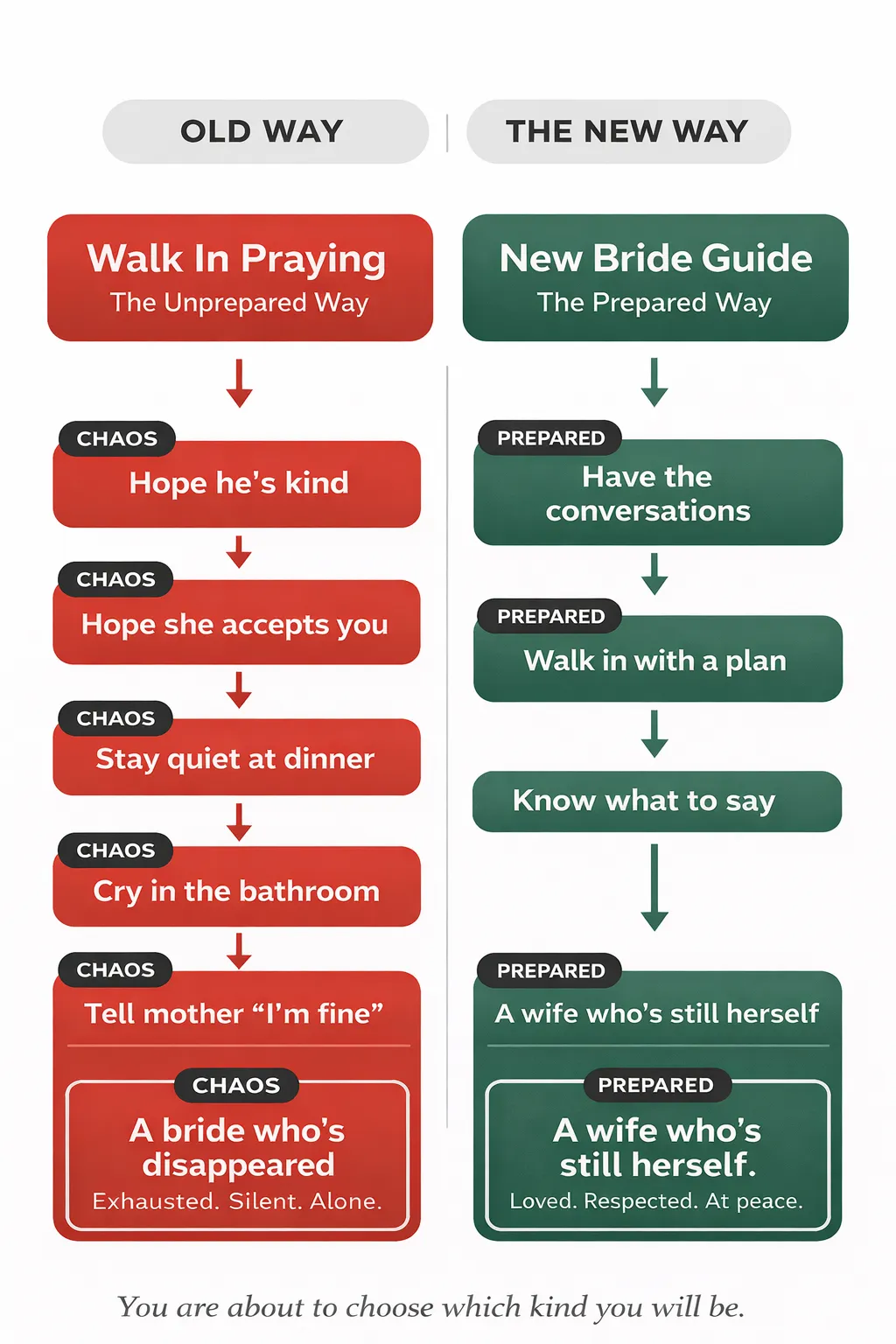
So are you going to walk into your sasural hoping, or are you going to walk in prepared?
Are you going to wake up in year three crying in a kitchen that doesn't feel like yours, or are you going to wake up laughing with the man you chose to marry?
Are you going to be Bride One, or are you going to be Bride Two?
Backed By Our Unconditional 30 Day Money Back Guarantee
Read it.
If it doesn't change something, take your money back.
Thirty days. No questions. No guilt.
Read the full book. Try the conversations. Use the scripts.
If thirty days from now you feel like it didn't give you a single thing your mother and your aunties couldn't have given you for free, send me one line and I will refund every rupee.
No questions. No "are you sure". No guilt.
You took a chance on me. The least I owe you is your money back if I let you down.
And If It's Truly Important To You
That you walk into your sasural prepared instead of praying...
That your saas one day introduces you as meri beti and means it...
That your husband still looks at you in year five the way he did at the nikah...
That you keep your job, your friends, your laugh, your own money, your own self...
Then what could be more important than two evenings of reading and Rs. 1500, right now, today, before the mehndi?
You were smart enough to land on this page.
You were brave enough to read this far.
You are definitely smart enough to know the girl who prepares is the girl who wins.
The only question left is this:
Will you look back on tonight as the night everything changed for you?
Or will you look back on it as the night you almost did, and didn't?
Get all these in just single Guide...
Frequently Asked Questions
Need help? [email protected]
Will my parents or in-laws know I bought this?
No. The download is private. You can read it on your phone with the door closed and nobody will ever know.
What if my fiance finds out I read it?
He will probably respect you more, not less. A girl who prepares for her marriage is not plotting against him. She is taking the marriage seriously.
How long does it take to read?
Two evenings. Long enough to give you everything you need. Short enough that you will actually finish it before the wedding.
Is this Islamic?
Yes. Every chapter is written within the boundaries of what a Pakistani Muslim wife would practice. Nothing in this book conflicts with the idea of a respectful, modest, faithful marriage. It teaches you how to protect one.
When should I read it?
Ideally thirty days before your nikah. But even one week before, even the night before, even the week after, this book will help you. Most of it is about what happens after the wedding, not before.
What if I am already married?
This book is built for the bride-to-be, but the conversations and frameworks work for the first three years of any Pakistani marriage. Many women in their first year have told me they wish they had read this earlier.
What if I don't have the courage to have these conversations?
You will. Every script is written for a girl who has been told her whole life to stay quiet. You don't need to be brave. You just need to know what to say.